Parent Check
PEGI 3- Contact with strangersLow–medium. Online visits need Nintendo Switch Online; on Switch 2, GameChat for under-16s is limited to parent-approved friends.
- Pressure to spendLow. Bells and Nook Miles are earned in play only; spending is limited to the game, expansion and membership.
- Violence & scary bitsLow. Gentle and slow-paced; the only violence noted is very mild, pixelated, in optional retro mini-games.
- "Just one more" pullMedium. The island follows the real clock and calendar, so events and visitors invite short daily check-ins.
- Content made by other playersLow–medium. Players visit each other's islands and can create custom designs; content stays within the game's own items.
PEGI 3, suitable for all ages. The Nintendo Switch 2 Edition (January 2026) notes occasional very mild, pixelated violence in classic Nintendo mini-games that can be placed on islands; the Happy Home Paradise expansion is also PEGI 3. Dials are our editorial view of documented features (1 = low concern, 5 = high), not test scores. How we score.
Is it right for my child?
Slide to your child's age. Nothing is stored or sent.
Animal Crossing: New Horizons at a glance
| Age rating | PEGI 3 |
|---|---|
| Platforms | Nintendo Switch; Switch 2 Edition (15 January 2026) |
| Price model | Paid game; Bells and Nook Miles earned in play |
| Online play | Needs Nintendo Switch Online (paid membership) |
| Players on one island | Up to 8 (original); up to 12 online on Switch 2 Edition |
| Paid extras | Happy Home Paradise expansion; Switch 2 upgrade pack |
| Time design | Follows the console's real date and time |
Tonight's three moves +XP
Tick them off as you go. Your progress is saved on this device only.
An island that keeps the same time as your kitchen clock
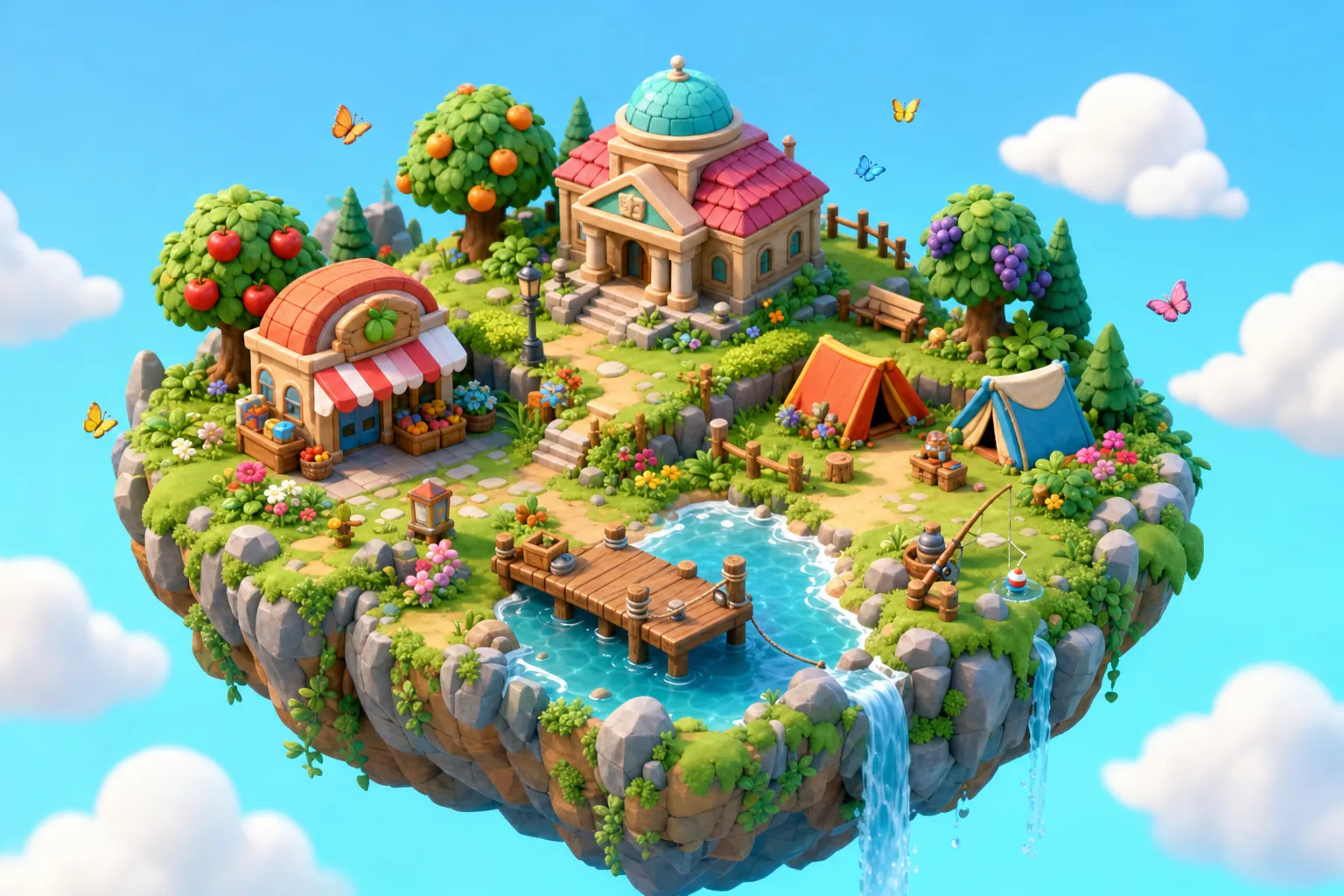
Animal Crossing: New Horizons, first released for the Nintendo Switch in 2020, drops your child on a quiet island where they build a home, gather materials, craft furniture and make friends with animal villagers. There are no enemies to defeat and no way to lose.
The detail that shapes everything is time. Nintendo explains that the game follows the real date and time on the console: the time of day and seasons match real life, and life on the island goes on even when nobody is playing. Shops open and close, the weather changes and the seasons turn on the same calendar as yours.
For parents, that means two things. It's a game played in small pieces over months rather than in one long sitting. And it naturally invites a daily visit – which we look at below.
It's also a game that many adults play, which is useful: if you've never picked up a controller, this is one of the easiest games to share with your child. You don't need quick reflexes, and there's no way to "ruin" their island by being bad at it.
Fishing, fossils and furniture: an evening on the island
A typical session is pottering with a purpose. Your child might:
- catch fish and bugs, or dig up fossils;
- gather wood, stone and fruit to craft furniture and tools;
- chat with villagers, who each have their own personality and routines;
- redecorate their house or landscape the island;
- take on small tasks to earn rewards.
Nintendo also highlights time-sensitive events such as special holidays and fishing tournaments that come and go, so one day can feel different from the next.
There's a lot of on-screen text. Villagers speak in written dialogue, which is lovely reading practice for confident readers and a reason younger children may want you nearby.
Sessions don't have a natural "end of level". Instead, children tend to stop when they've finished the day's jobs – emptied their pockets, watered the flowers, checked the shop. Asking "what do you want to get done today?" at the start gives everyone a shared finish line.
Bells, Nook Miles and the absence of a cash shop
Animal Crossing has two in-game currencies, and neither is sold for real money in the game:
- Bells – the everyday money, earned by selling items such as fish, fruit and furniture in the island shop.
- Nook Miles – a rewards points system earned through activities and daily island life. Nintendo says Miles can be used for things like new recipes, bigger pockets and tickets for trips to other islands.
We found no loot boxes, battle pass or premium currency. The real-money costs sit outside the island:
- the game itself (or the Switch 2 Edition);
- an optional paid expansion, Happy Home Paradise, in which players design holiday homes on a resort archipelago;
- an upgrade pack for existing owners who want the Switch 2 Edition;
- a Nintendo Switch Online membership for online play.
All of these go through the Nintendo eShop, which you can lock in your Nintendo Account (see our Switch controls guide). For the bigger picture on how other games charge, our in-game spending explainer is a useful comparison.
Airport visits, friends' islands and the Switch 2 megaphone
Animal Crossing can be played entirely alone. Contact with other people only happens if your child goes online or plays locally with others.
Visiting islands. Players travel through the island's airport to visit friends or welcome visitors. Nintendo's page for the original game says up to eight people can play together on one island via local wireless or online play. Online play needs a paid Nintendo Switch Online membership.
Who can come? Visits are usually arranged between friends. The risk rises if your child shares a code to their island in public places such as social media or forums, where people outside the family could arrive. A simple house rule – "we only open the island to people we know" – covers most of it.
Switch 2 Edition extras. Nintendo lists online play for up to 12 players on one island, GameChat for talking to friends while playing, CameraPlay with a compatible camera, and an in-game Megaphone that uses the console's microphone to call out to characters on the island. On Switch 2, under-16s can only use GameChat once you've linked the parental controls app, and you approve each chat friend individually.
It's worth remembering that a visit isn't just a conversation: visitors walk around your child's island while they're there. For a child who has spent weeks planning a garden, having someone they don't know wander through it can feel surprisingly personal. Visits with school friends or cousins, arranged in advance, tend to be the happiest kind – and they're a lovely way for children who live apart to play together.
Our guide to online chat and strangers has ideas for talking this through with children.
Turnips, birthdays and seasons: the gentle pull of tomorrow
Animal Crossing doesn't use flashing rewards or timers on a shop. Its pull is quieter: because the game runs on the real calendar, there is nearly always something happening today that won't be there tomorrow – a visitor, a seasonal event, a new item in the shop, a villager's birthday.
For most children this creates a pleasant routine of a short visit each day. For some, it becomes a worry about "missing" things, or a reason to ask for the Switch before school.
Ways to keep it healthy:
- Pick a regular slot – after homework, say – rather than first thing in the morning.
- Use the Play Time Limit in the Nintendo Switch Parental Controls app, including a bedtime window.
- Reassure them that seasons come round again next year, and most events return.
Our page on screen time and routines covers this sort of habit in more depth.
Design, patience and reading practice: why many parents like it
Animal Crossing has a strong reputation with families for good reasons:
- Creativity. Children plan an island layout, decorate rooms and create custom patterns – on the Switch 2 Edition, with mouse controls using the Joy-Con 2.
- Patience and planning. Projects take days of real time, so children learn to work towards something gradually.
- Reading. Dialogue is everywhere, at a gentle pace the child controls.
- Calm. There's no fighting, no losing and no countdown in most of what you do, which makes it a good wind-down game when used with sensible limits.
- Collecting and nature. Collecting fish, bugs and fossils through the seasons gently teaches children to notice and tell things apart.
Switch 2 Edition, version 3.0 and Happy Home Paradise, untangled
There are now several versions and add-ons, which can be confusing at the till:
- Animal Crossing: New Horizons – the original Switch game.
- Version 3.0 – a free update released on 15 January 2026 for both Switch and Switch 2 owners.
- Nintendo Switch 2 Edition – released the same day, with higher resolution on TV, mouse controls, the Megaphone, GameChat, CameraPlay and online play for up to 12 players on one island.
- Upgrade pack – lets existing owners move to the Switch 2 Edition without buying the whole game again.
- Happy Home Paradise – a paid expansion, also PEGI 3.
Nintendo notes that this game does not support the Save Data Cloud feature of Nintendo Switch Online, so an island can't simply be restored from a cloud backup. If your child has spent months on an island, treat the console with care.
If you're deciding between versions: the original game plays on both consoles, while the Switch 2 Edition adds the newer features. For a family with an original Switch, there's no need to change anything – the free version 3.0 update brings new content to both.
Also keep an eye on the Nintendo Switch Online membership. It's needed for online island visits and GameChat, and it is a subscription on your Nintendo Account. If you'd rather your child played offline only, you can simply not renew it for their account.
Before the first flight: settings for an Animal Crossing family
The controls are the same as for any Switch game; our Nintendo Switch controls guide has full steps. For this game, focus on these:
- Link the free Nintendo Switch Parental Controls app to the console using the six-digit registration code.
- Set a Play Time Limit, and consider a bedtime window so evening island visits don't run late.
- Under Restricted Features, choose whether your child can communicate with others. Remember the setting applies to the whole console, so set it for your youngest player.
- On Switch 2, open GameChat in the app and approve each friend separately for each child's profile. Decide whether video chat may be requested.
- In your Nintendo Account, go to Family Group, choose your child and tick Spending Restrictions (and Age-Based Purchase Restrictions if you want), then Save changes.
Once it's set, the app's play activity view shows how long the island is getting each day. That's helpful for spotting whether a happy daily habit is starting to stretch, and it gives you facts rather than guesses when you talk about it.
If you'd rather allow spending with a cap – for example, if your child is saving pocket money for the expansion – Nintendo also lets you add a fixed amount using a Nintendo eShop card, so they can only spend what's on the balance.
Our view: a low-risk island with one habit to watch
Animal Crossing: New Horizons is about as gentle as mainstream games get: PEGI 3, no real-money currency inside the game and no pressure to compete. Contact with other people is opt-in and, on Switch 2, voice chat for under-16s is limited to friends you approve.
The thing to keep an eye on is the daily rhythm the real-time clock creates. Agree when the island gets its visit, use the play-time tools, and it can be one of the calmest parts of your child's gaming week. See our 7-9 and 10-12 pages for how it sits alongside other games.
Parents also ask about Animal Crossing: New Horizons
Is Animal Crossing suitable for a 5 year old?
It's rated PEGI 3, so the content is suitable. The main challenge for a five-year-old is the amount of reading, so many children of that age enjoy it most with a grown-up nearby to read the dialogue.
Does Animal Crossing: New Horizons have in-game purchases?
The in-game money, Bells and Nook Miles, is earned by playing and isn't sold for real money. Paid extras are bought separately through the eShop: the Happy Home Paradise expansion and an upgrade pack for the Switch 2 Edition.
Can strangers come to my child's Animal Crossing island?
Only if your child plays online and opens their island to visitors. Visits are usually arranged between friends, so the risk mainly arises if your child shares an island code publicly. Online play needs Nintendo Switch Online.
What is the Animal Crossing Switch 2 Edition?
Released on 15 January 2026, it adds higher resolution, mouse controls, an in-game Megaphone, GameChat, CameraPlay and online play for up to 12 players on one island. Existing owners can buy an upgrade pack instead of the full game.
Why does my child want to play Animal Crossing every day?
The game follows the console's real date and time, so events, visitors and shop stock change daily. Agreeing a regular slot and using the Switch's Play Time Limit helps keep it a routine rather than a worry.
Does Animal Crossing have voice chat?
On the Switch 2 Edition, players can talk to friends with Switch 2 GameChat. Under-16s can only use GameChat after a parent links the Nintendo Switch Parental Controls app and approves each friend.
Sources we checked
Facts on this page were checked against these sources on 3 November 2026. Settings and ratings change, so if something looks different on your screen, tell us and we will re-check.
- https://pegi.info/search-pegi?q=Animal+Crossing
- https://www.nintendo.com/en-gb/Games/Nintendo-Switch-games/Animal-Crossing-New-Horizons-1438623.html?nsuid=70010000027620
- https://www.nintendo.com/en-gb/Games/Nintendo-Switch-2-Edition/Animal-Crossing-New-Horizons-Nintendo-Switch-2-Edition-2950861.html
- https://animalcrossing.nintendo.com/new-horizons/explore/
- https://www.nintendo.com/en-gb/Hardware/Nintendo-Switch-Parental-Controls/Nintendo-Switch-2-Nintendo-Switch-Parental-Controls-2873385.html
- https://www.nintendo.com/en-gb/Support/Parental-Controls/Guide-for-Parents-Guardians-Managing-your-Child-s-GameChat-Experience-with-Parental-Controls-2843765.html
- https://www.nintendo.com/en-gb/Support/Nintendo-Switch/How-to-Set-Nintendo-eShop-Restrictions-1406403.html